
 Continue with Google
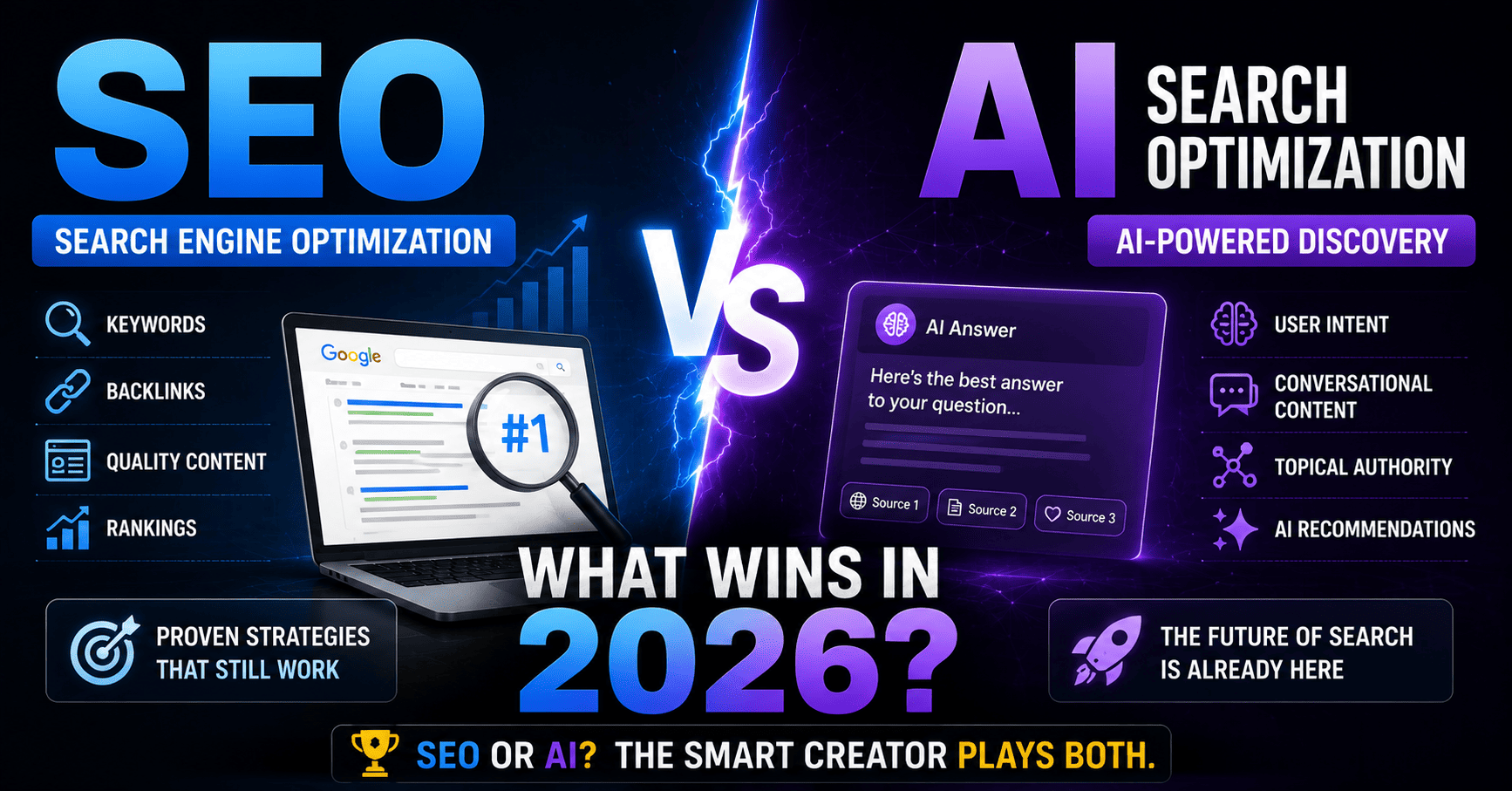
SEO vs AI Search Optimization: What Matters in 2026?
Search has changed faster in the last two years than it did in the previous decade.
Traditional SEO still matters, but AI-powered search systems are changing how people discover content, trust information, and click websites. If your strategy still revolves around stuffing keywords into blog posts and building random backlinks, you’re already behind.
In 2026, the real battle is no longer just about ranking #1 on Google.
It’s about becoming the source AI systems choose to cite.
That shift changes everything.
After analyzing modern search behavior, AI Overviews, and content patterns across high-ranking websites, I noticed a major trend: websites winning in 2026 are blending traditional SEO with what I call AIO (AI Intent Optimization).
This article breaks down:
The difference between SEO and AI search optimization
What still works in Google rankings
What AI search systems prioritize
The future-proof strategy smart creators are using now
What Is Traditional SEO?
Search Engine Optimization (SEO) is the process of improving content so search engines rank it higher in results pages.
Traditional SEO focuses on:
Keywords
Backlinks
Technical optimization
Site speed
Internal linking
Metadata
Search intent
For years, SEO worked like a competition for visibility.
The better your optimization, the higher you ranked.
And honestly, many websites abused this system by publishing:
Thin content
Rewritten articles
Keyword-heavy pages
Low-value affiliate spam
That strategy is collapsing in 2026.
What Is AI Search Optimization?
AI Search Optimization is the process of creating content that AI-powered search systems can:
Understand quickly
Trust confidently
Extract answers from
Cite in summaries
Recommend to users
This includes optimization for:
AI Overviews
Search Generative Experience (SGE)
Conversational search
AI assistants
Voice search systems
Instead of ranking webpages only, AI systems now rank answers.
That means structure, clarity, originality, and authority matter more than ever.
The Biggest Difference Between SEO and AI Optimization
Traditional SEO asks:
“How do I rank higher?”
AI Search Optimization asks:
“How do I become the best answer?”
That mindset shift is huge.
In older SEO, you could sometimes outrank better content with stronger backlinks.
In AI search systems, generic content struggles because AI models prefer:
Clear explanations
Trusted expertise
Structured answers
Original insights
Concise information blocks
The internet is moving from link ranking to answer ranking.
The A.I.O Framework for 2026
The websites dominating in 2026 follow what I call the A.I.O Framework:
A — Authority Signals
AI systems prefer content that demonstrates:
Real expertise
Experience
Strong topical depth
Trustworthiness
This includes:
Original case studies
Data-backed insights
Unique frameworks
Expert analysis
Generic rewritten articles are increasingly ignored.
I — Intent Matching
Search intent is evolving beyond keywords.
AI systems analyze:
Context
User goals
Follow-up questions
Conversational patterns
For example:
Old SEO target:
“best laptops for students”
Modern AI intent:
Budget?
Battery life?
Gaming?
Engineering software?
Portability?
Winning content answers multiple intent layers naturally.
O — Optimized Structure
AI models love structured content.
That means:
Clear headings
Concise paragraphs
Bullet points
FAQs
Tables
Direct answers
Messy walls of text perform poorly because AI systems struggle to extract information cleanly.
Structure is now a ranking advantage.
What Still Matters in Traditional SEO?
Some people claim SEO is dead.
That’s completely wrong.
Many traditional SEO factors still matter heavily in 2026.
1. Backlinks Still Matter
Authority links remain important because they help validate trust and credibility.
However, link quality matters far more than quantity now.
Five strong niche-relevant backlinks outperform 500 spam links.
2. Technical SEO Still Matters
Your site still needs:
Fast loading speed
Mobile optimization
Crawlability
Clean architecture
Proper schema markup
AI systems cannot trust or process poorly structured websites effectively.
3. Search Intent Is Still King
Google’s core goal hasn’t changed:
Deliver the best answer for the user.
That means understanding intent remains critical.
The difference is AI search systems evaluate intent much more deeply now.
What Matters More in AI Search Optimization?
1. Originality
This is the biggest shift.
AI-generated generic content is flooding the web, which means originality is becoming a competitive advantage again.
AI systems increasingly reward:
First-hand experience
Unique frameworks
Contrarian opinions
Real examples
Fresh research synthesis
The safest strategy in 2026 is publishing content nobody else could write exactly the same way.
2. Atomic Answers
AI systems prefer content chunks that answer specific questions clearly.
For example:
Bad:
Long, vague explanation with filler.
Good:
Direct, concise answer followed by expanded context.
This is why FAQ sections perform extremely well today.
3. Semantic Depth
Modern search systems analyze topic completeness, not just keywords.
A strong article about email marketing should naturally mention:
Open rates
Deliverability
Segmentation
Automation
CTR
A/B testing
Funnels
Topical coverage builds AI confidence.
SEO vs AI Optimization: Which Is More Important?
The answer is both.
But the balance has changed dramatically.
Here’s the new reality:
Traditional SEO | AI Search Optimization |
|---|---|
Helps you rank | Helps you get cited |
Focuses on keywords | Focuses on answers |
Prioritizes backlinks | Prioritizes authority |
Optimizes pages | Optimizes information |
Measures clicks | Measures usefulness |
The future belongs to websites combining both strategies together.
The Biggest Mistake Website Owners Are Making
Many creators are panicking and trying to “game AI.”
That’s a mistake.
The smartest publishers are doing something simpler:
They’re becoming genuinely useful.
Google’s 2026 updates increasingly reward:
Human experience
Real expertise
Helpful depth
User satisfaction
Original perspectives
Low-quality AI spam might still generate temporary traffic, but it rarely builds lasting authority.
How to Future-Proof Your Content in 2026
Here’s the strategy I believe will dominate the next few years.
Build Topical Authority
Instead of publishing random articles, build deep expertise around one niche.
Example:
SEO
AI tools
Personal finance
Cybersecurity
SaaS marketing
Topical depth improves both rankings and AI trust.
Create Information Gain
Ask yourself:
“What does my article add that doesn’t already exist?”
That single question changes content quality dramatically.
Write for Humans First
Ironically, the best AI optimization strategy is creating deeply human content.
Use:
Personal insights
Stories
Testing
Opinions
Clear explanations
AI systems increasingly detect shallow content patterns.
Final Verdict: What Actually Matters in 2026?
SEO is not disappearing.
It’s evolving.
The websites winning in 2026 are combining:
Traditional SEO fundamentals
AI-friendly structure
Original expertise
Intent-driven content
Information gain
The era of publishing average content at scale is ending.
Search engines and AI systems are both moving toward the same goal:
rewarding genuinely valuable information.
If your content teaches better, explains deeper, and helps users faster, you’ll survive the AI search era.
If not, rankings alone won’t save you anymore.
FAQ
Is SEO still relevant in 2026?
Yes. Traditional SEO still matters for visibility, indexing, and rankings, but AI optimization is becoming equally important.
What is AI Search Optimization?
AI Search Optimization focuses on creating structured, trustworthy, and answer-focused content that AI systems can cite and recommend.
Are keywords still important?
Yes, but keyword stuffing is outdated. Semantic relevance and search intent matter more.
What type of content performs best in AI search?
Original, well-structured, experience-driven content with concise answers performs best.
Will AI replace Google Search?
AI will likely reshape search experiences, but search engines will continue evolving rather than disappearing completely.
What is the best strategy for ranking in 2026?
Combine technical SEO, topical authority, AI-friendly formatting, and original insights into one unified content strategy.